When the machines write everything
The cost of producing plausible prose has fallen close to zero. The volume arriving at every desk rises, the value per page falls, and the scarce thing stops being writing. It becomes attention that has actually been paid.
What this piece argues
- Cheap prose raises volume and lowers the value density of the average page
- Triage becomes the dominant reading mode, and speed at triage compounds
- Machines can read much of it — but accountability does not delegate
- When text is cheap, proof of comprehension becomes the valuable artefact
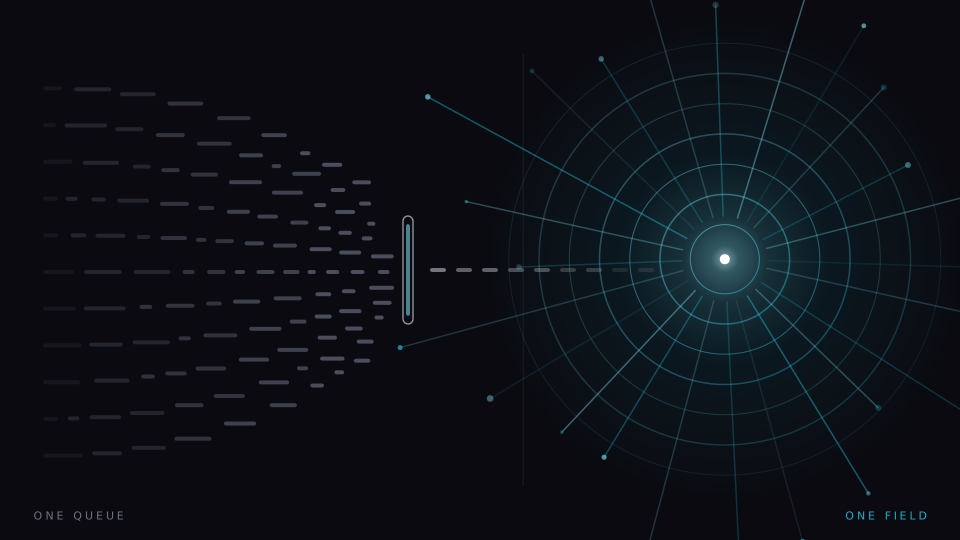
Something has changed about the economics of text and almost nothing has changed about the economics of reading. Producing a page of competent, structured, grammatical prose used to cost an hour of someone’s attention. It now costs a few seconds and a fraction of a penny. The reading side of that transaction did not get cheaper. It is still 200 to 300 words a minute, still bounded by the same machinery, still one person in a chair.
That asymmetry is the entire story, and its consequences are more mundane and more corrosive than the usual framing suggests. Nobody is drowning in brilliant machine-written literature. They are drowning in the ordinary stuff: the memo, the summary of the memo, the update on the summary, the policy document that used to be a paragraph and is now a section with headings.
We should say at the outset that we are inside this loop rather than observing it. This app pairs words with images, and a large fraction of those images are drawn from open sets or generated procedurally by machine. We are a company using machine-made pictures to help people read machine-made prose. That does not make the argument wrong, but it does mean we owe you the uncomfortable version of it at the end.
Volume up, density down
The mechanism is simple enough to describe in one sentence: when the marginal cost of a page falls, the number of pages rises and the average page is worth less. What that looks like in practice is specific and recognisable. The report that was four pages is fourteen, because expanding it took no effort and length still reads as diligence. Internal documentation inflates, because writing the extra section is now cheaper than deciding it was unnecessary. Every request for comment attracts more comments. Every proposal arrives with an appendix.
The ratio that matters is not the total volume. It is text-that-must-be-read against text-that-rewards-reading, and that ratio is moving in the wrong direction. A fourteen-page document containing four pages of content is not merely longer; it is harder, because the reader now has to locate the content as well as understand it. Padding is not neutral. It is a search cost imposed on everyone downstream of the person who declined to edit.
So the scarce resource stops being the writing. It becomes attention that has actually been paid — the difference between a document having been circulated and a document having been read by somebody who could now answer a question about it. We try to keep an honest account of it in the attention ledger. That resource was always scarce. What has changed is that everything competing for it got cheap at once, and there is no corresponding mechanism that makes reading cheap.
Triage becomes the main event
For most professional readers, the dominant mode is no longer reading a document. It is deciding which document, and which part of it, deserves reading properly. That was already true for anyone doing discovery, literature review or diligence. It is becoming true for people who used to have small enough inboxes to read them.
Triage rewards a particular kind of speed, and it is not the kind the speed-reading industry sold. It is not comprehension at four times the rate — nobody has that and nobody will. It is the ability to move through a pile at a rate that keeps the pile finite while retaining enough of each item to know which one to go back to. The advantage compounds, because the person who finishes the pile discovers the paragraph that matters, and the person who does not finish it never learns what was in the part they skipped.
- Sampling is legitimate. Skimming is a real and useful skill. It is not reading, and the failure mode is doing it while believing otherwise.
- Triage is a decision, not a summary. The output is not what the document said. It is whether this one gets a slow, careful, sceptical second pass.
- Volume changes the calculus. When there were ten documents, reading all of them properly was possible. At two hundred, refusing to triage is itself a choice to miss things.
- The second pass still has to happen. A contract, a proof, a diagnosis or anything you intend to argue with deserves slow reading with a pen, and no tool changes that.
The advantage isn’t reading faster. It’s finishing the pile and finding the paragraph nobody else reached.
What triage actually buys
The obvious objection
If a machine wrote it, why not have a machine read it? The symmetry is neat and the objection is serious, and for a great deal of text the answer is simply yes. Status updates, meeting notes, the third restatement of a position you already hold, most of what arrives as a courtesy copy: have it condensed, read the condensation, move on. We are not going to pretend that is a loss. We say the same thing, at more length and with the boundaries drawn, in summaries are not reading.
The limit is not about quality. Summarising systems are good and getting better. The limit is that accountability does not delegate. Someone signs the contract. Someone is responsible for the clause. Someone answers for the guideline that was not followed, the disclosure that was missed, the sentence in the filing that turned out to matter. When a decision has a name attached to it, the person whose name it is has to have read the thing — not because a machine could not have read it adequately, but because when the question arrives afterwards, the summary did not mention it is not an answer anyone accepts.
That is a narrower category than the total volume of text, and it is the category that has not become cheaper. Everything else can be compressed. The part that carries consequences still requires a person who has been through it, and the volume of that part goes up too, because contracts and filings and clinical guidance are also being produced by systems that find length inexpensive.
Proof of comprehension becomes the artefact
Here is the second-order effect that interests us most. When text is abundant and cheap, the valuable object is no longer the text. It is the evidence that a particular person actually absorbed a particular document. That evidence barely exists today. Attestation systems in most organisations record that a page was opened, which is a measurement of a click. Training compliance records that a video finished playing. None of it is a measurement of understanding, and everybody involved knows it.
A tool that reports a rate is not close to that. A tool that reports a rate and a recall score is closer — not there, but on the right axis. This app ends a passage with a check that mixes words which genuinely appeared with plausible distractors, puts the score beside the speed, and exports the session as a plain-text report including settings and history. It is designed to be unflattering, because a flattering number would be worthless. That artefact is a small, early, honest version of the thing we think becomes valuable.
There is a further risk in this direction that we would rather name than discover. The moment a comprehension score becomes valuable, it becomes worth gaming, and any test simple enough to run after every passage is simple enough to defeat. We do not have a good answer to that. The partial answer is that a measure kept for your own use, on your own device, with nobody to impress, has nothing to gain from being gamed — which is an argument for keeping it a personal instrument rather than an institutional one for as long as possible.
The symmetry we cannot argue our way out of
Return to the loop. Machines write a growing share of the text. We pair that text with imagery that is itself largely machine-produced — restyled open-source icons, morphological overlays composed automatically, and a procedural tier that derives a mark from the letters of a word with no semantic content whatsoever. On the worst case, that is a machine-generated picture attached to a machine-generated sentence, presented to a human being who is trying to get through a pile before a meeting.
We do not think that is indefensible, but we think there is only one thing that makes it defensible, and it is not the quality of the pictures. It is being measurable. Every image in this app is labelled with the resolver tier that produced it, so a reader can see which ones came from the hand-drawn set and which came from the floor. Every session can be exported with its rate and its recall history attached. Neither of those makes the loop virtuous. They make it inspectable, which is the most any participant in this can honestly offer — and considerably more than a system that shows you a rising number and asks you to feel good about it.
A note on what this is. Signal is written in-house by the team that builds Reader Inc., so treat it as an argument rather than a review. Nothing here is medical, psychological or educational advice, and the app is not a treatment, therapy or diagnosis for any condition. Where we describe research we describe it in general terms; where we are reasoning past the evidence we say so. The app is free, runs entirely on your own device, and ships with a comprehension test switched on — which means you can check every claim we make against your own reading rather than taking our word for it.
Read next
Summaries are not reading
The machine summariser is the newest member of the speed-reading family and the most seductive, because for triage it is often the correct tool. It is also somebody else’s compression, and compression is a series of judgements you never get to see.
The next decade of reading machines
Forecasts about reading technology usually describe the screen and forget the reader. Here is an attempt at the opposite — one constraint that will not move, five that will, and the only frontier we think is worth competing on.
The comprehension tax
Every reading product quotes words per minute, a figure that is trivially easy to inflate and means nothing on its own. Here is how to benchmark a speed reader honestly, including this one, and what you will probably find.