The attention ledger
The failure most readers describe is not an inability to concentrate. It is arriving at the bottom of a page having taken in none of it, going back, and losing the thread again — a loop that costs time and then costs confidence.
What this piece argues
- A static page supplies no pace and makes every part of itself available at once
- An external pace helps some readers and adds pressure for others
- A visible end matters because open-ended tasks are disproportionately hard to start
- ADHD is diagnosed and managed by clinicians; this is a reading tool, nothing more
You reach the bottom of the page and realise you have no idea what was on it. Not a word of it stuck. So you go back to the top, read it again more deliberately, and somewhere around the fourth line the same thing happens. Ten minutes have gone. The paragraph is still unread, and something worse has started: you have begun to suspect you are bad at this.
That loop is the thing worth designing against, and it is badly described by the word most often used for it. This is not an inability to concentrate. People who describe it will also describe three hours lost to something absorbing the previous evening. The capacity is there. What fails is the maintenance of it against a task that supplies no external structure — a task where nothing happens if you stop, nothing marks progress while you continue, and nothing tells you which of the last four minutes were real reading.
It is worth saying immediately that this is not only a story about ADHD. Attention difficulties of exactly this shape arrive at the end of a long day, in the fourth hour of a document review, in the week after a bad night with a small child, and in the middle of a chapter you genuinely want to read. Some readers live with a diagnosed condition and some are simply tired, and the page does not distinguish between them. Much of what follows applies to both, which is a reason to describe the mechanism rather than the population.
Why a page is a difficult object
Two properties of a static page make it harder than it looks. The first is that it does not move. Nothing external maintains the pace, so the pace has to be supplied entirely from inside the reader, continuously, for as long as the reading lasts. On a good day that is free. On a bad one it is the whole job, and the reading is what gets dropped when the supply runs out. The page will wait indefinitely and register nothing, which is a courtesy right up until it becomes the problem.
The second is that every part of the page is available at once. The eye can go anywhere, and it does — down to the bottom of the column, across to the facing page, out to the figure, back to the sentence it was on, which is now four lines up and no longer obviously the right one. Some of that movement is skilled reading behaviour and some of it is drift, and from the inside they are difficult to tell apart. A reader who has lost their place has usually lost it to somewhere else on the same page.
The mechanisms, and where each one stops
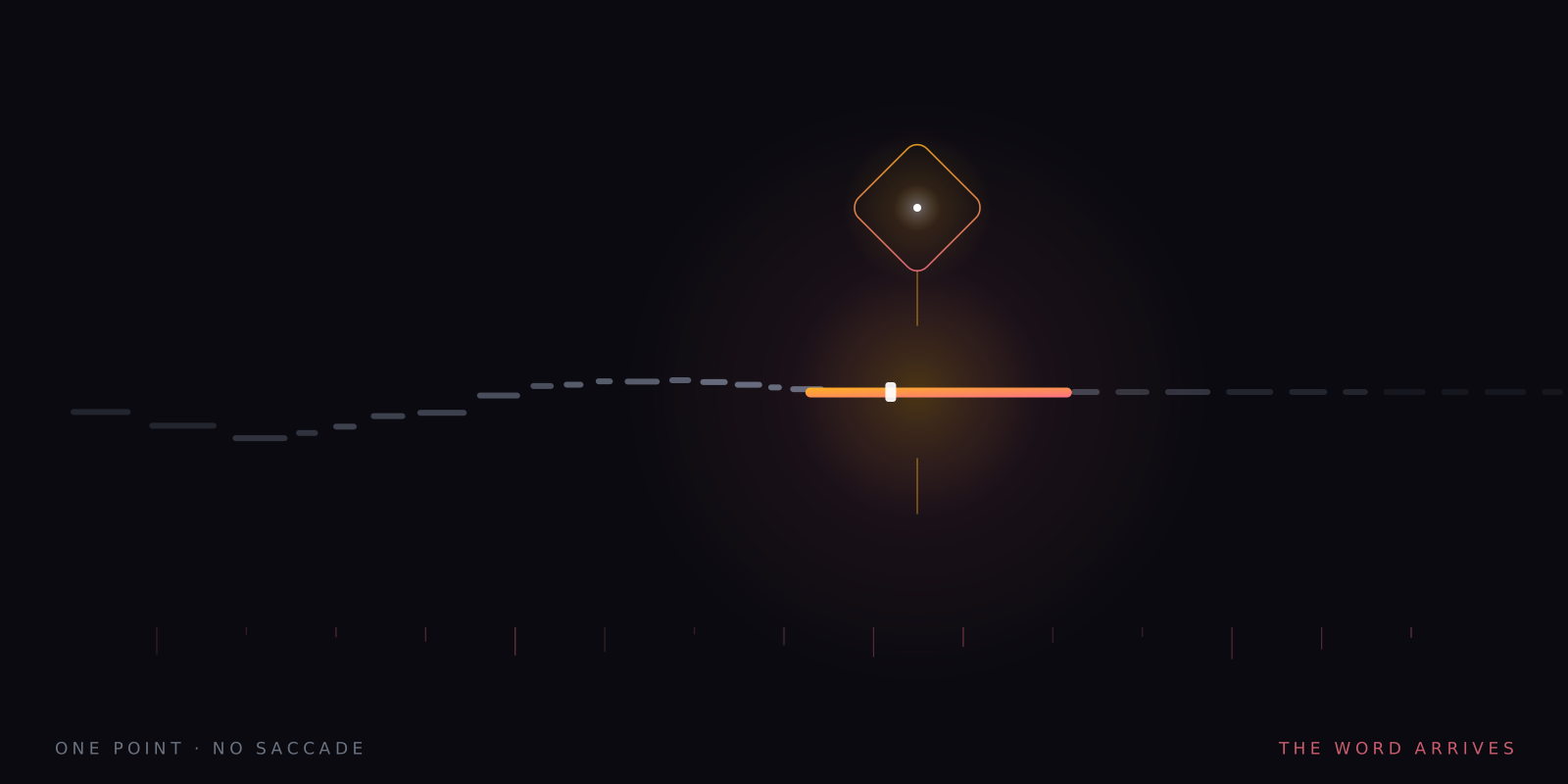
An externally paced stream changes both properties at once. The words keep arriving whether or not you are supplying momentum, so the pace stops being something you generate and becomes something you keep up with — a different kind of effort, and for some readers a much cheaper one. And there is only one place to look, because there is only one word on the screen. Attention is given a single target instead of a field. Neither of those is a claim about improvement; they are descriptions of what changes.
- The pace is external. You are no longer generating momentum, which removes one continuous cost. It also means the pace can be wrong for you, and a stream that is slightly too fast is worse than a page.
- One target, not a field. A single word at a fixed point gives the eye nowhere else to go. The drift has no destination. The corollary is that you cannot glance ahead or back either, which is sometimes exactly what you needed.
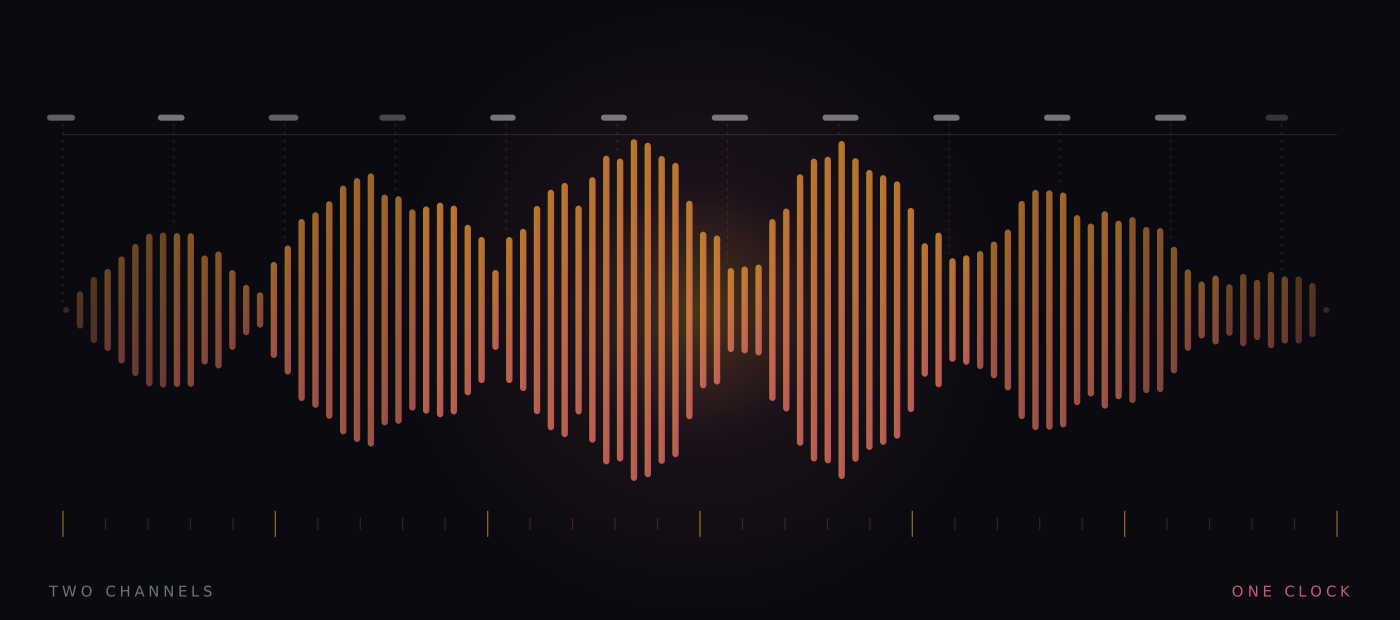
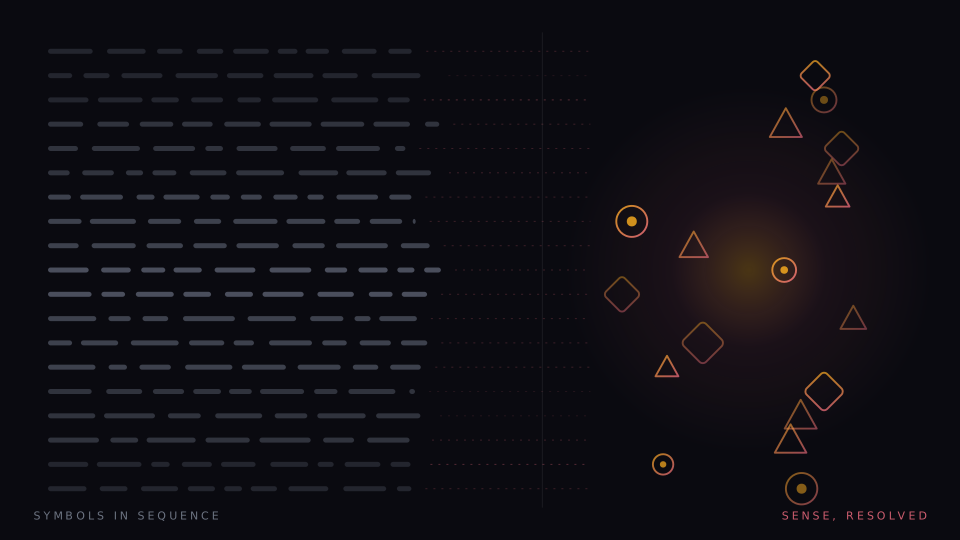
- The imagery channel gets a job. Every word is paired with an icon chosen by sense. Our reasoning — and it is reasoning, not a finding — is that the channel which wanders off and starts writing its own material is better occupied than left idle.
- The end is visible. Remaining time is shown honestly rather than hidden, and a passage has a finite length you can see. Open-ended tasks are disproportionately hard to begin, and this makes the task small and bounded before it starts.
- There is a completion state. Each passage ends in a recall check that mixes words which genuinely appeared with plausible distractors. Reading becomes a task you can finish and be scored on rather than an activity you eventually abandon.
The last two deserve more weight than they usually get. Retrieval practice is well supported in the memory literature — being tested on material improves retention more than re-reading it does — so the check earns its place on the evidence rather than on the psychology of finishing things. But that psychology is doing real work too. A page has no state. You are either reading it or not, and you can be not-reading it for a long time before anything notices. A passage with a length, a countdown and a score at the end is a different object entirely, and the difference is felt at the moment of starting.
A page has no completion state. You can fail to read one for an hour and nothing will mention it.
Why starting is the hard part
The counterweight
Everything above has a mirror image, and it would be dishonest to bury it. External pacing is also pressure. A stream that outruns you does not produce calm focus; it produces a specific and unpleasant anxiety, because the words are leaving and you cannot get them back, and the harder you try to catch up the less of the sentence survives. For some readers the removal of control is precisely the problem rather than the solution. Being able to slow down mid-paragraph, stop, reread the clause and resume is not a bad habit. It is how a lot of people read difficult things successfully.
Which produces the only piece of advice we are confident about: start slower than feels natural. Not slightly slower — noticeably slower, somewhere around 120–180 wpm, well below an ordinary adult rate of roughly 200 to 300. The instinct on first use is to push the number up, because the number is right there and looks like the point. It is not the point. If the stream is going to help you, it will help you at a slow setting, and if it only works when it is fast then what you are experiencing is pressure, which wears off and takes the comprehension with it.
Hyperfocus, without the romance
Hyperfocus is real and it is frequently described as a superpower by people who do not have to live around it. The absorbed state is genuine and productive, and it also arrives unbidden, attaches itself to whatever is in front of it rather than whatever matters, and is difficult to exit. Reading in that state can be extraordinary. Reading in it for four hours when the thing due tomorrow was something else is a cost, not a gift, and a tool that makes reading more absorbing is not automatically doing a reader a favour. Time limits, breaks and an alarm in another room are not a lack of ambition.
A ten-minute first session
If reading has become hard to start, the worst possible opening move is a long document at a high speed. Here is a smaller one. It takes about ten minutes, it uses your own material, and it is designed to produce an answer rather than an experience.
Pick something short and real
Two or three paragraphs of something you actually have to read — not a demo passage, not a novel you are trying to enjoy. It parses on your machine and uploads nothing, so it can be the coursework or the contract.
Set the pace low and leave it
Start at 150 wpm. Resist the number. You are testing whether the fixed point and the single target do anything for you, and that question is not answered any better at 400.
Turn the voice on
KittenTTS nano runs in the browser, eight voices, locked to the display so hearing and seeing arrive together. If it feels like too much at once, turn it off and note that you preferred it off — that is data.
Set motion to taste, including none
One slider scales all animation at once, down to zero. Some readers find the movement anchoring and some find it noise. Try one setting per session rather than changing everything at once.
Take the recall check
Do not skip it because you know how it went. You do not — the whole subject of this article is the gap between how reading felt and what stayed. The check exists to close that gap.
Stop when the passage ends
Resist the second passage on the first day, especially if it went well. Finishing something small on purpose is the habit worth building. The pile will still be there tomorrow.
Run that three or four times across a week and you will know something reasonably solid: whether an external pace steadies you or crowds you, and whether the recall score at a slow setting is better or worse than what you get from a page. Both answers are useful and one of them saves you from a tool that does not suit you. If the stream turns out to be the wrong shape for your attention, the ordinary tactics still stand — shorter sessions, a timer, one document at a time, the thing you are avoiding first — and none of them require our software.
What we would ask is that you judge it on the score rather than the feeling. Reading that feels effortful is often reading that worked, and reading that feels smooth is often the one that left nothing behind, which is exactly the trap the loop at the top of this article sets. The app shows recall next to speed for that reason, and will happily tell you that your comprehension collapsed two hundred words per minute ago. That is the number to trust. It has no interest in flattering either of us.
A note on what this is. Signal is written in-house by the team that builds Reader Inc., so treat it as an argument rather than a review. Nothing here is medical, psychological or educational advice, and the app is not a treatment, therapy or diagnosis for any condition. Where we describe research we describe it in general terms; where we are reasoning past the evidence we say so. The app is free, runs entirely on your own device, and ships with a comprehension test switched on — which means you can check every claim we make against your own reading rather than taking our word for it.
Read next
The pace that watches you
Adaptive reading is coming, and most of it will optimise for the wrong thing. A survey of the signals — behaviour, eyes, wearables, brainwaves — and the design argument that matters more than any of the sensors.
Decoding is not comprehension
Dyslexia is a difficulty with word recognition, decoding and spelling. It is not a difficulty with thinking. That distinction decides which tools are honest, which are useless, and what a presentation setting is entitled to claim.
What we will not claim
The accessibility market has a long habit of shipping confidence ahead of evidence. We sell a reading app, so the habit is available to us too. This is the list of sentences we have decided not to write.