Reading with ADHD
The page is finished and nothing arrived, so you go back to the top. On reading with ADHD: the re-reading loop, why an externally set pace can be a metronome or a cage, and how to find out which it is for you.
What this piece argues
- The re-reading loop is an attention failure, not a decoding one
- An externally set pace can carry attention along — or run off without it
- A recall check is the only honest way to know whether a pace is helping
- We have not tested the app with ADHD readers, and we make no clinical claims
The eyes did the work. They moved left to right, line after line, all the way down the page — and nothing arrived. Somewhere in the second paragraph attention left the building, and the eyes carried on alone, dutifully, like a tour guide addressing an empty bus. So you go back to the top and run it again, and sometimes again after that. People with ADHD describe this loop more consistently than almost anything else about reading, and it is the loop this piece is about.
Start by placing the difficulty correctly, because it is a different animal from the one we usually write about on this desk. In dyslexia the bottleneck is decoding — turning letterforms into words — while comprehension waits intact behind it. In the re-reading loop the decoding went fine. The words were recognised; some were even subvocalised. What failed was attention: the binding of those words into meaning that gets kept. Different bottleneck, different tools, and advice for one transplanted onto the other tends to fit badly.
It helps to notice what kind of task continuous prose is. It is self-paced, silent, and structurally flat — no scene changes, no one else’s turn, nothing external marking progress except the slow crawl of a page number. Every single line ends with an unspoken decision to continue to the next one. For a reader whose attention feeds on novelty and external structure, prose is close to a worst case: the medium supplies neither, and then blames the reader. That framing is ours, not a clinical finding, but it is hard to look at a page and unsee it.
The loop, up close
The eye-movement literature gives the loop a small, respectable cousin. Even skilled readers make a regression — a backwards saccade — on roughly one movement in seven, and many of those are comprehension failures rather than motor slips: the system notices that meaning has stopped arriving and goes back for it. The re-reading loop is that same repair, scaled up from a phrase to a page. The mechanism is ordinary. What differs is how often it fires, how far back it reaches, and how much of an evening it eats.
The cost is not only time, though the time cost is real enough when three readings buy one reading’s comprehension. The heavier cost is what the loop teaches. Each silent restart files another small piece of evidence that reading is something you are bad at, and people reliably drift away from tasks that keep telling them that. The avoidance then looks like the problem — you should read more — when it is downstream of the loop, not upstream of it.
A pace you do not set
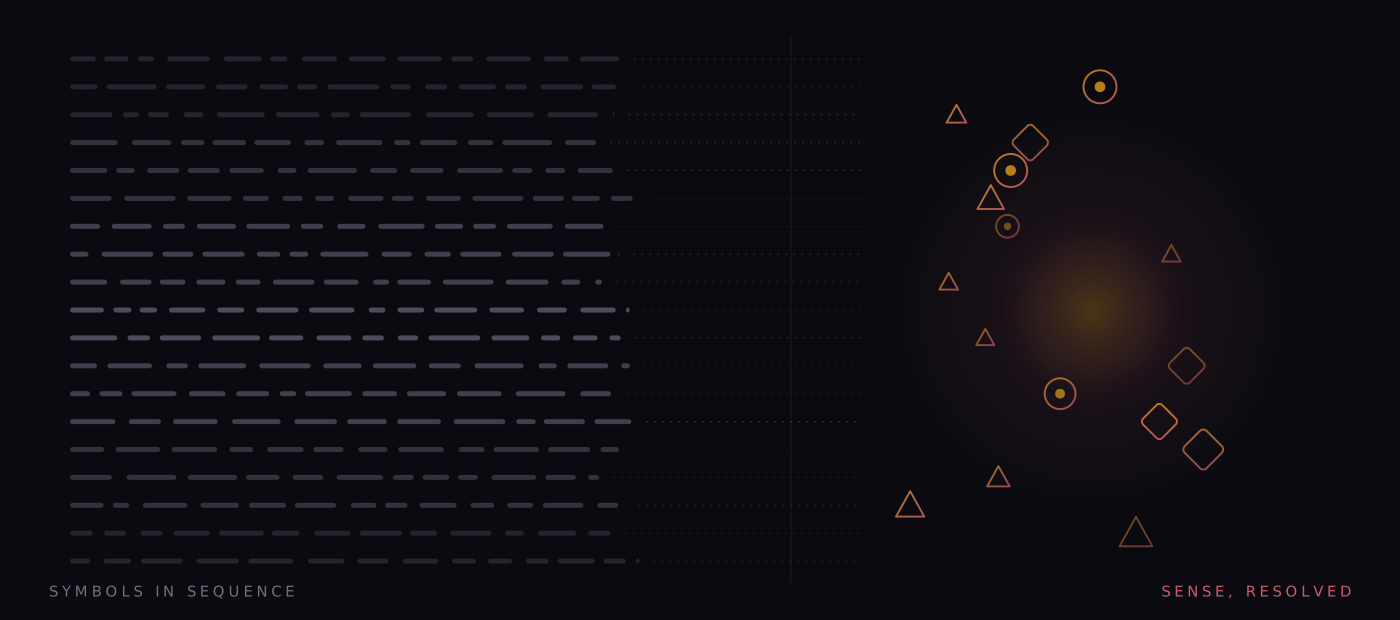
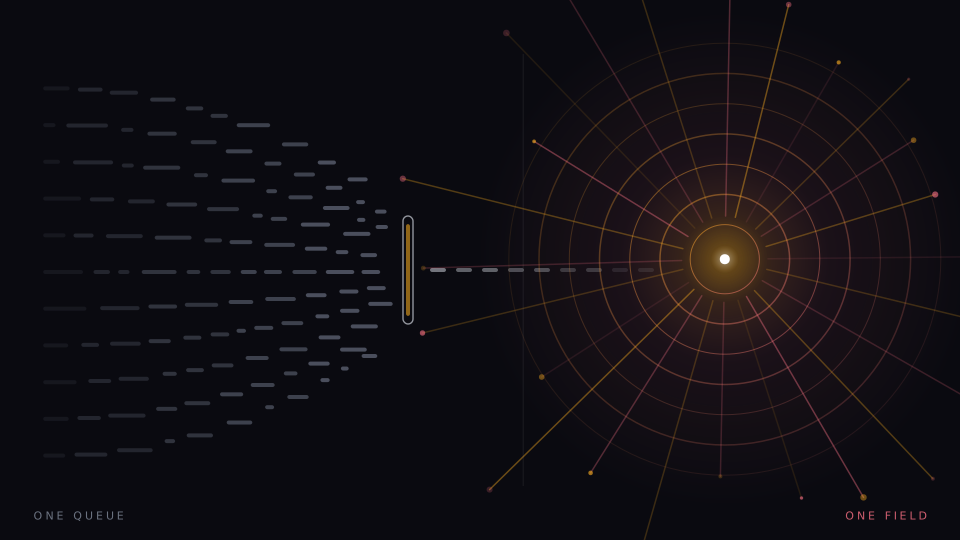
Here is the bet a tool like ours makes for this audience, stated as a bet. The app presents one word at a time, at a fixed point, at a rate you choose — and once the stream starts, the pace is no longer being decided by you, line by line. There is nothing ahead to skip to and nothing beside the word to wander into; the next word simply arrives, whether or not attention went looking for it. The hope is that the rhythm works like a metronome for a practising musician: an external clock that carries the task along, converting a hundred small decisions to continue into one decision to begin.
There is a second, quieter mechanism in the same design. On a page, keeping your place is itself a task — the line you were on, the paragraph you had reached — and place-keeping is exactly the sort of low-stakes housekeeping that a wandering attention drops first. A fixed point has no place to keep. Nothing about focus while reading is guaranteed by that, but the list of jobs competing for attention is genuinely shorter, and shortening that list is the whole design.
And the cage
Now the same design, described by its critic. A set pace assumes attention is continuous, and in ADHD that is precisely the assumption that does not hold. On a page, a lapse is cheap: the text waits, and the cost is a re-read. In a stream, the words that arrived during the lapse are gone — there is no page to return to, and the reader surfaces to a sentence missing its middle. The metronome, for that reader in that minute, has become a cage: a pace that punishes the very variability it was meant to help. Both descriptions are true. Which one describes you, on which material, at which hour of the day, is not something we or anyone can tell you from here.
The app blunts this where the text itself predicts trouble — dwell stretches up to 2.8× on long words, commas, sentence ends and paragraph breaks, so the rhythm breathes with the prose rather than ticking flatly through it. But that stretching follows the structure of the text, not the state of your attention; the machine has no idea you have gone. What a pace that genuinely watched the reader would look like is a live question, and we have written about it separately in the pace that watches you.
One more honest variable: the app pairs words with animated icons, and for this audience that cuts both ways. Extra stimulation may be exactly what keeps a restless attention aboard, or it may be one more moving thing to watch instead of the word. We genuinely do not know which way it goes for whom. What we can say is that it is your call, not ours — one slider scales all animation down to zero, word-only mode exists, and the system’s reduced-motion preference is obeyed without being asked.
On a page, a lapse costs a re-read. In a stream, the words are gone.
The trade, stated plainly
Recall is the ground truth
The feeling of having concentrated is a poor witness — the loop itself proves that, since every lap of it began with the impression of reading. So the question does the pace help me should never be settled by impression. The app’s recall check exists for exactly this: after a passage, a short test mixing words that genuinely appeared with plausible distractors, scored next to your speed. Retrieval practice is also one of the better-evidenced things in learning — testing beats re-reading for retention — so the check is not just a measurement, it is a small intervention in its own right. How we think about attention and what it costs is set out in the attention ledger.
The experiment worth running takes two evenings. Read one passage as an ordinary page and take the check. Run a comparable passage through the app at a modest rate — the point is attention, not speed, so there is no shame anywhere on the slider — and take the check again. Then, and this is the part that matters for this audience, repeat both at a different time of day, because attention is not one fact about you. If the stream scores better, you have learnt something real. If the page wins, you have learnt something equally real and saved yourself a tool.
An experiment of one
Reading advice for people with ADHD tends to arrive as universal law — always this format, never that one — and the loop’s own lesson points the other way. Attention varies by person, by material, by medication, by hour; the honest unit of knowledge here is the experiment of one, run on your own documents and scored against your own recall. A pace that cages one reader carries another, and the same reader can be both in one day.
What the loop takes away is not intelligence and not even comprehension — it is the reliable arrival of text into a mind that was ready for it. Any tool that improves that arrival, measured and not merely felt, earns its place in the routine. Any tool that does not, however clever its mechanism, goes back on the shelf. The score decides. That is the whole method, and it fits in an evening.
A note on what this is. Signal is written in-house by the team that builds Reader Inc., so treat it as an argument rather than a review. Nothing here is medical, psychological or educational advice, and the app is not a treatment, therapy or diagnosis for any condition. Where we describe research we describe it in general terms; where we are reasoning past the evidence we say so. The app is free, runs entirely on your own device, and ships with a comprehension test switched on — which means you can check every claim we make against your own reading rather than taking our word for it.
Read next
The attention ledger
The failure most readers describe is not an inability to concentrate. It is arriving at the bottom of a page having taken in none of it, going back, and losing the thread again — a loop that costs time and then costs confidence.
The pace that watches you
Adaptive reading is coming, and most of it will optimise for the wrong thing. A survey of the signals — behaviour, eyes, wearables, brainwaves — and the design argument that matters more than any of the sensors.
Choosing a reading app for dyslexia
Any reading app for dyslexia is making claims the moment it names its audience. Five questions separate the honest tools from the wishful ones — and because fairness demands it, our own app answers them last.