Let the word come to you
Word-by-word presentation removes eye movement completely, and eye movement is a real cost. It is also a much smaller cost than the speed-reading industry needs it to be. Here is the arithmetic, with nothing rounded up.
What this piece argues
- Around 10–15% of reading time is spent moving the eye, not reading
- Removing saccades, the return sweep and place-keeping is a genuine but modest saving
- Language processing is the bottleneck, which is why fourfold claims cannot be true
- The stream takes away re-reading, and that is a real loss we design around
The eye does not glide along a line of text. It jumps, lands, holds for about a fifth of a second, and jumps again — and during every jump you are functionally blind. What feels like a smooth passage through a paragraph is a sequence of still glimpses stitched together after the fact. Almost everything the speed-reading industry sells is an attempt to edit that sequence.
A competent adult reads continuous prose at roughly 200 to 300 words per minute. That figure has barely shifted across a century of measurement, through every change in typography, schooling and screen. It is not a bad habit waiting to be corrected, and it is not evidence that readers are lazy. It is what the machinery costs. The first honest question to ask of any reading method is which part of that cost it proposes to remove, and what it proposes to put in the space.
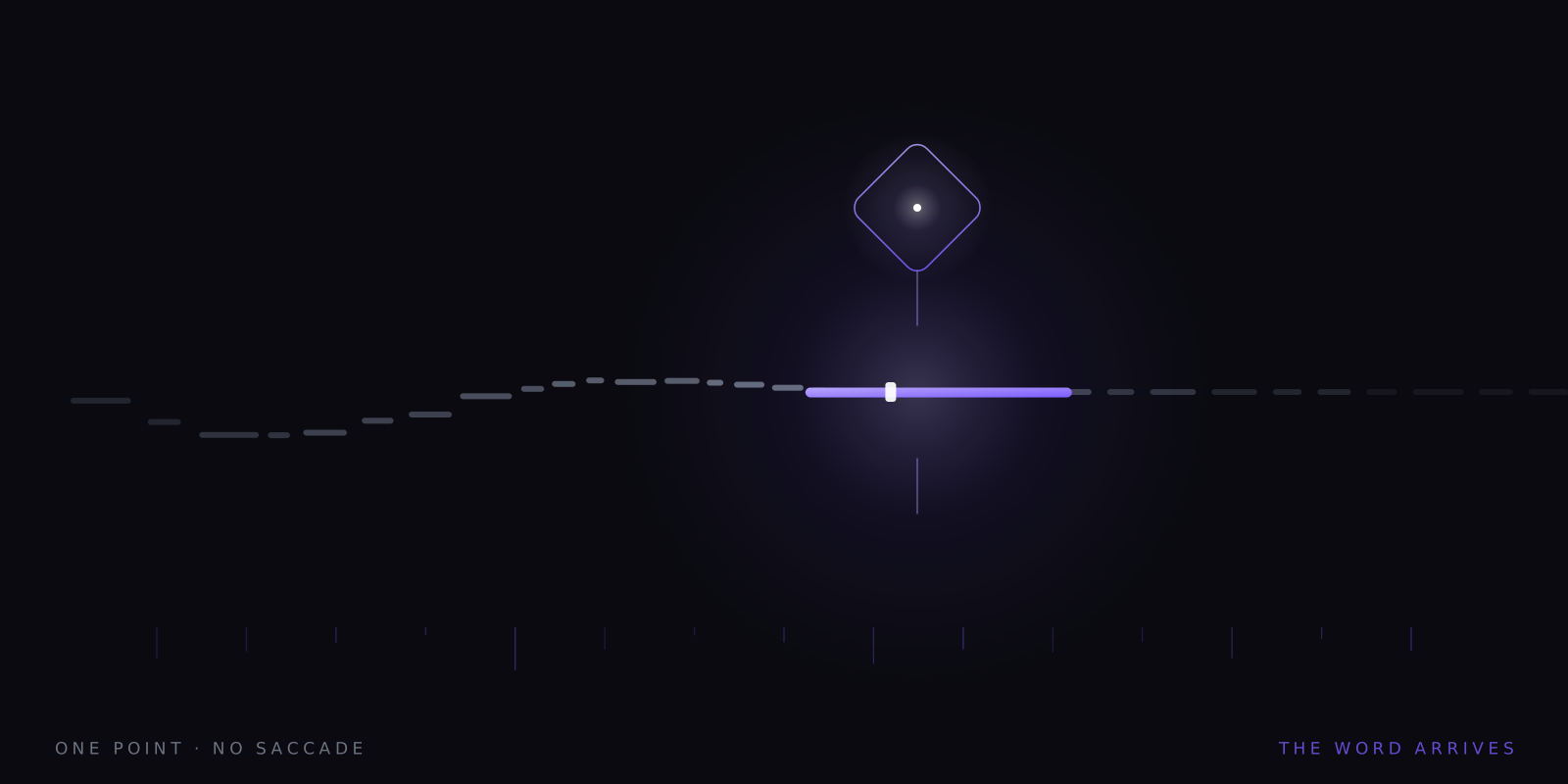
Reader Inc. removes one part outright. The word comes to a fixed point instead of your eye going to the word — no line, no page, no place to keep. That buys something real and mechanical. It also buys considerably less than the advertising around this technique implies, and the distance between those two sentences is the subject of this piece.
What a saccade costs
Fixations last roughly 200 to 250 milliseconds. Between them the eye jumps seven to nine characters forward, and during the jump it takes in effectively nothing. Add up all those blind intervals across a page and you get something in the region of ten to fifteen per cent of total reading time spent in motion rather than in intake. That is the headline quantity, and it is worth holding on to, because it is the largest single thing that fixed-point presentation can genuinely reclaim.
There are two smaller items on the same bill. The return sweep — the long backwards jump from the end of one line to the beginning of the next — costs more than an ordinary saccade and often lands imprecisely, so a corrective movement follows before reading resumes. And there is place-keeping: the quiet, mostly unconscious work of knowing which line you are on, not reading it twice, and not skipping the one below. None of these is dramatic alone. Together they are the mechanical overhead of a page, and a stream of single words simply does not have them.
The jump that goes backwards
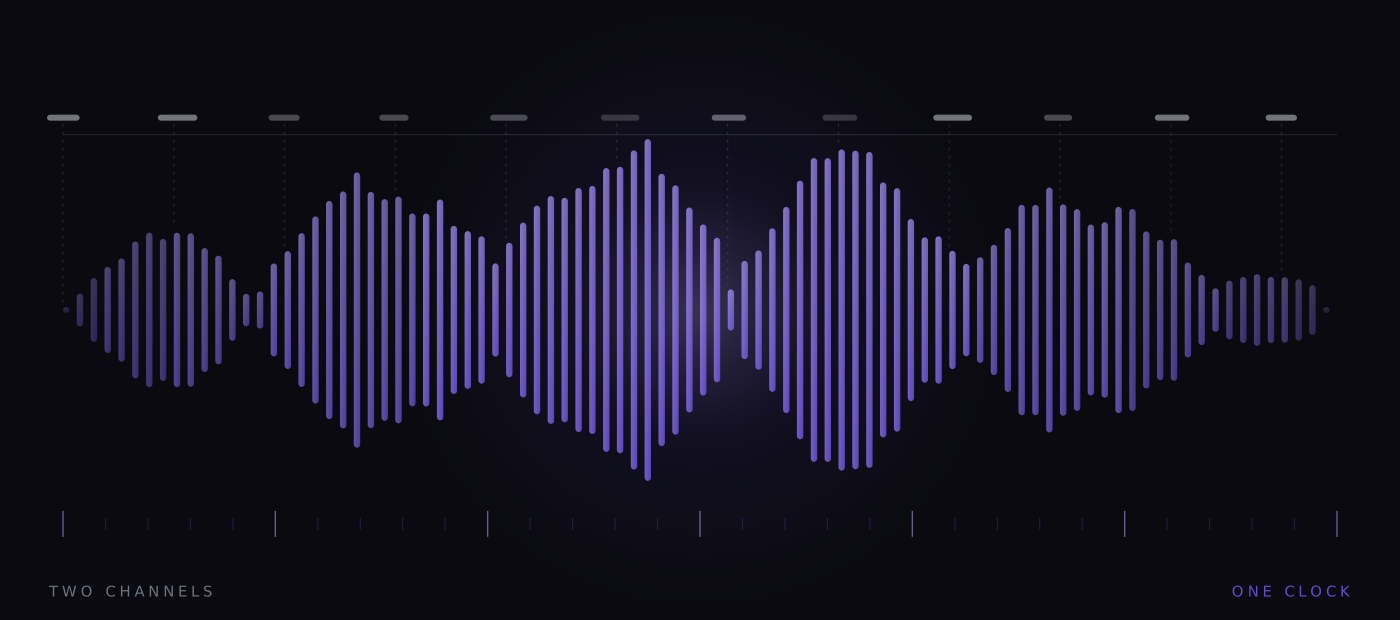
The regression is the interesting entry. Skilled readers make a backwards saccade on roughly one saccade in seven. Some of those are motor corrections: the eye overshot its target and comes back. But a substantial share are not motor events at all. They are the visible signature of a sentence that failed to resolve — the reader reached a clause boundary without a coherent reading, and the repair strategy is to go back and look at the words again.
Which changes how you should read that number. A tool that abolishes regressions is not purely removing waste; it is removing a repair mechanism at the same time. If a backwards jump was fixing a comprehension failure and you delete the jump without deleting the failure, the failure stays and the reading feels smoother. That is the worst possible combination, because a smooth experience is exactly what readers use to judge whether they understood something.
The honest sum
Set the mechanical savings out in the open. Motion time, the return sweep, place-keeping, and the flanking letters that crowd a word on a printed line. All four are real. All four disappear when a single word arrives alone at a fixed point. None of them requires you to believe anything about willpower, peripheral vision or the untapped potential of the brain.
- Saccadic motion. Ten to fifteen per cent of the time, reclaimed outright. This is the one saving in the whole field that is mechanical rather than aspirational.
- The return sweep. Gone entirely, along with the corrective movement that often follows an imprecise landing at the start of a line.
- Place-keeping. There is no line to lose and no paragraph to hold a position in, so the class of error disappears rather than being reduced.
- Crowding. A word alone has no neighbours interfering with letter recognition — the limiting case of increased spacing, and free as a side effect.
Removing eye movement buys real time. It does not buy you a different language system.
The ceiling, stated plainly
The wall
Now the part that ends most of the claims in this industry. When researchers strip eye movements out completely and present words one at a time at a fixed point — which is precisely what this app does — reading gets somewhat faster. Not multiples faster. Somewhat. The result has been replicated often enough to be treated as settled, and its interpretation is not subtle: the limiting factor was never how quickly you could see words. It is how quickly you can integrate them into meaning.
That single finding disposes of the fourfold promise. If vision were the bottleneck, removing the eye movement would produce a step change, and it does not. Once the eye is out of the equation you are arguing with the language system itself, and the language system does not have a slider. Anything advertising a four-times gain with comprehension intact is either measuring skimming, which is a legitimate and useful skill but is not reading, or measuring nothing at all. We are not exempt from this. We use the same presentation technique, and it puts the same ceiling over us.
So stop attacking the eye
If the ceiling is comprehension rather than perception, then optimising perception further is a dead end, and the field has spent decades finding that out expensively. The interesting move is a different one: leave the eye alone and look at the channel. Language arrives as a queue of symbols decoded in sequence, at whatever rate the inner voice permits. That queue is the constraint. Adding pressure to it does not widen it.
So we pair every word in the stream with an animated icon chosen by sense — not by spelling, and not by keyword lookup. The bet is that meaning can be delivered through a route that is not waiting in the verbal queue, and that above roughly 400 words per minute, where subvocalisation has fallen away because there is no longer time for it, something needs to take over the work the inner voice was doing. That argument is set out properly in the second channel. The hard engineering problem underneath it — choosing the right sense of a word in a quarter of a second — is its own article, and its own long list of failures.
What the stream takes away
Here is the cost we cannot design around, only mitigate. Words in a stream vanish. When a sentence turns out to be structurally harder than it looked — a relative clause nested two deep, a negation whose scope you misjudged, a pronoun that resolves three lines back — the ordinary reader’s response is to look again, immediately and almost without noticing. In RSVP that option is gone by construction. On syntactically dense prose this is a genuine loss, and it is the strongest argument anyone can make against this entire class of tool.
So the app is built around the assumption that you will need to go back. There are step-back keys and a full restart. Dwell is stretched rather than held constant: up to 2.8× at paragraph breaks, with smaller stretches at sentence ends, commas, numerals and long words, so integration time exists where the prose actually needs it. Words read counts the furthest point you reached rather than the total displayed, so rewinding cannot inflate the number. And every passage ends with a recall check that mixes words which genuinely appeared with plausible distractors, which will tell you without ceremony that your comprehension collapsed two hundred words per minute ago.
None of that makes the loss disappear. It makes it visible, which is the most we think a reading tool is entitled to promise. Take a passage you already know well, run it once as plain text and once with the stream, and answer the questions both times. If the number goes down, the number goes down — you will have learnt something true about your own reading in forty minutes, which is more than a page of claims can offer you. The app is free, runs entirely on your machine, and has no incentive to flatter you.
A note on what this is. Signal is written in-house by the team that builds Reader Inc., so treat it as an argument rather than a review. Nothing here is medical, psychological or educational advice, and the app is not a treatment, therapy or diagnosis for any condition. Where we describe research we describe it in general terms; where we are reasoning past the evidence we say so. The app is free, runs entirely on your own device, and ships with a comprehension test switched on — which means you can check every claim we make against your own reading rather than taking our word for it.
Read next
The second channel
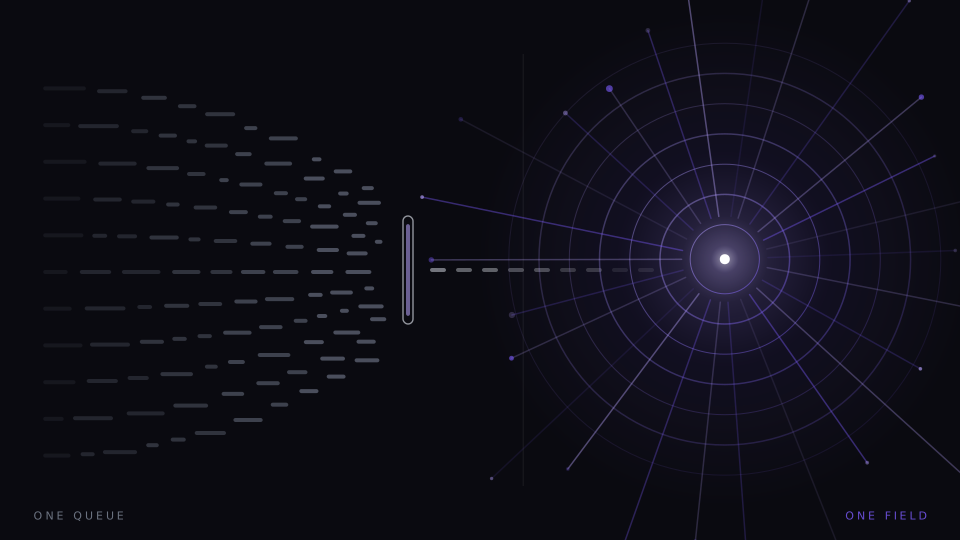
Most reading tools treat pictures as ornament. In this one the picture is structural — it is there to carry the load that the inner voice drops when the words start moving too fast to pronounce.
The comprehension tax
Every reading product quotes words per minute, a figure that is trivially easy to inflate and means nothing on its own. Here is how to benchmark a speed reader honestly, including this one, and what you will probably find.
A field guide to speed readers
Six different machines share one shelf in the app store, and they do not do the same job. What each family removes, what it puts back, and where the evidence runs out — including for ours.